Design a Gunsmith finish with distinct but related regions
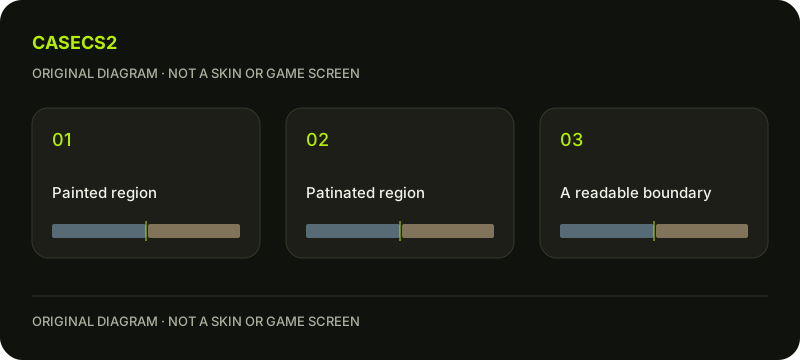
Plan the relationship between two material regions before judging the entire weapon image. Valve describes Gunsmith as combining Patina and Custom Paint styles. An original design exercise can ask whether painted and patinated areas support one idea, whether the transition reads intentionally and whether one region overwhelms the other in the normal player view.
CASECS2Updated:
Assign two clear region roles
Imagined area
Intended role
Review question
Painted region
Carry a simple focal motif
Is the motif readable?
Patinated region
Provide a calmer supporting impression
Does it support rather than compete?
Boundary between them
Connect the design idea
Does the transition feel deliberate?
Use an original abstract motif and a supporting material study. These are imagined roles, not a named skin or a measured weapon layout. A strong region in isolation may still conflict with the neighboring one, so retain the boundary as its own design question.
A check diagram, not a game screen.
Write the relationship before changing materials
Choose whether the design should feel strongly divided or subtly related across its regions. Neither is automatically better. The important point is knowing which relationship you intended before the rendered result encourages an improvised explanation.
The in-hand composition guide helps establish the relevant perspective. Identify what is visible there and what supporting details appear during inspection. Do not demand equal emphasis everywhere just because two material regions are available; one can intentionally carry more information while the other provides visual breathing room.
Inspect each region under the same conditions
Keep the model, light, view and wear preview recorded. Describe the painted region’s readability first, then the supporting region’s response. Avoid changing both while you are still trying to identify the source of a problem.
The roughness and alpha guide addresses specific channel interpretation separately. A region looking different is not enough to invent a universal parameter or a hidden editor control. Use the current supported fields for your actual setup and keep the visual observation distinct from any technical explanation you have not established.
Treat the transition as a third comparison
Inspect the area where the two regions meet. Ask whether a contrast change supports the model’s shape or looks accidentally abrupt. A deliberate boundary can work well without pretending the material is continuous. Record the intended effect in plain language.
If apparent depth contributes to the impression, consult the normal-map guide for that separate concept. Do not describe a lighting effect as newly added geometry or a real chemical process happening to an owned weapon. The test concerns the appearance of your original authoring study under its recorded conditions.
Revise one relationship and recheck the whole
Prepare a variant changing one focal or supporting choice, then inspect the same region and boundary views again. Return to the normal player perspective before deciding whether the change helps the composition. A better local transition can still weaken the broader hierarchy.
The lighting guide helps prevent a scene change from being credited to the revision. The PBR albedo guide also separates source color from rendered lighting. Keep those influences apart so that the design note can explain why the selected variant was retained.
Keep the design result separate from release claims
Record each region’s role, the intended transition and the views that support your conclusion. If the result is still uncertain in one view, keep that question open rather than filling it with a rarity label or a predicted price.
The submission review guide explains later publication and selection boundaries. A completed two-region exercise does not create an inventory item or change one you own. Its value is a clearer composition and a repeatable next step, with technical interpretation and actual evidence kept attached to the relevant area.
Explore a material idea with the Patina exercise, comparing original warm and cool versions in the same view.
Sources checked on 2 November 2026. Labels and locations can vary by client version and language. Match the described state in your own current interface.
Help
Questions and answers
What you should know before you begin.
Must both regions be equally prominent?
No. Assign roles that serve the intended composition and check the actual player view.
Does a boundary need to disappear completely?
Not necessarily. A deliberate division can be part of the design goal.
Does a material study change my existing weapon?
No. An authoring exercise and an owned game item are different things.