Compare paper, holographic and foil sticker ideas without legacy recipes
Valve’s sticker guide describes visual styles including glossy, paper-backed glossy, embossed foil and holographic treatments. Use it to understand material differences, not as an exhaustive current catalog or a verified current CS2 import recipe. Compare your own artwork across views and light, keeping the material concept separate from ownership, rarity and price.
CASECS2Updated:
Compare the concept, not a market label
Material concept
Visual question
What it does not prove
Paper-backed or glossy
Are shapes clear on the chosen backing?
A complete list of current styles
Holographic
How does appearance vary with view and light?
A guaranteed rarity or premium
Embossed foil
How does metallic relief read?
New physical geometry or item ownership
Imagine an original symbol made from a ring and two broad bars. Keep that artwork fixed while examining the material concept instead of substituting a famous existing sticker or inventing a market price.
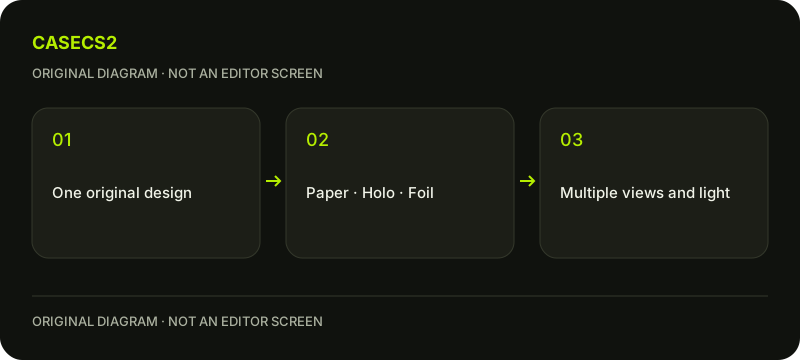
A check diagram, not a game screen.
Use the source as conceptual guidance
The official guide discusses several sticker styles, including glossy and paper-backed glossy, holographic and embossed foil. That list is useful for understanding visual mechanisms without asserting that it exhausts every current game style.
The page also contains older material and texture recipes. Do not copy its legacy commands, file formats, paths or numeric settings as verified CS2 production steps. The current finish-authoring context and official technical documentation should be checked for tools, while this article remains a visual design comparison rather than an import tutorial.
Keep the original artwork and conditions fixed
Use the same original symbol, size, background and comparable lighting for the first comparison. Inspect whether its shapes remain crisp and understandable. Do not paint scratches or grime into the artwork to imitate wear that the material workflow handles separately.
The lighting comparison guide offers a useful control principle. If artwork, backing and view all change together, it becomes unclear which material property caused the difference. Record what was actually held constant instead of presenting several unrelated pictures as a controlled experiment.
Inspect holographic variation across views
The guide describes holographic appearance varying with view and light through its spectral effect. One flattering angle cannot establish how the design reads as the view changes. Inspect several deliberate views and retain the conditions with the images.
Do not claim that a particular effect automatically means a rare or expensive inventory item. The catalog-versus-instance guide illustrates why a presentation image and a particular owned item are different evidence. Your own conceptual preview is another category again and should be labeled as authoring work.
Read foil relief separately from painted color
The guide’s embossed-foil concept uses a metallic relief impression associated with a normal map. Examine that surface response separately from the symbol’s color. A dark painted line and a lighting-based groove should not be treated as identical evidence.
The normal-map guide explains apparent depth without adding geometry. This conceptual comparison does not create a current sticker import prescription. It also does not convert a paper sticker you own into a holographic or foil variant; authoring material choices and inventory-item identity are separate systems.
End with a material-specific observation
Record which shapes remain readable, where the visual treatment changes with view and which areas need revision. Do not impose an unverified minimum number of styles for current submission or promise that one treatment will be selected. The submission review guide covers those boundaries separately.
For an already applied sticker, use the removal guide rather than an authoring comparison. No material experiment here promises safe application reversal, a price increase or a new owned item. The useful result is a clearer original design and an honestly scoped visual test.
For a simple silhouette, try the glossy sticker exercise and compare its shape and negative space at small size.
Sources checked on 2 November 2026. Labels and locations can vary by client version and language. Match the described state in your own current interface.
Help
Questions and answers
What you should know before you begin.
Is the guide’s style list the entire current catalog?
Do not assume so. It explains several visual concepts, not an exhaustive current inventory list.
Can I apply these ideas to convert my owned paper sticker?
No. An authoring material comparison does not change an existing item’s variant.
Are legacy format recipes verified current CS2 steps?
No. Keep older technical instructions separate from current supported tools and documentation.