Custom Paint: keep an original illustration readable on a weapon
Choose the part of your illustration that must survive a quick glance, then test its placement before adding detail. A complete drawing can still produce an unclear weapon composition. The exercise below uses an original crescent and branching lines to separate recognition of the main motif from appreciation of its smaller decoration. Valve describes Custom Paint as applying a full-colour image through existing UVs.
CASECS2Updated:
Plan a placement comparison
Original study
Change
Question
A
Crescent centred on the broad area
Is the main shape recognisable?
B
Same crescent moved within the composition
Does its outline survive better?
Detail check
Branching lines restored
Do they support or obscure the crescent?
Draw the crescent yourself and keep a plain version. The table describes a hypothetical composition, not an existing skin or a required tool preset. Keep the same artwork for A and B so that placement remains the decision you are testing.
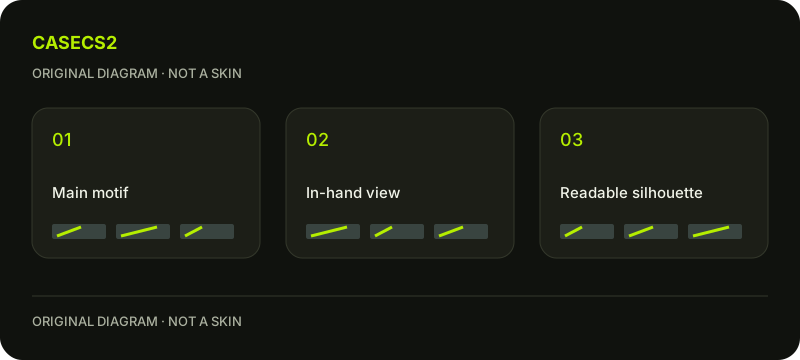
A check diagram, not a game screen.
Write a recognition target
Describe what a viewer should identify first: a crescent with a clear opening, for example. Avoid a target such as “looks detailed,” which gives no way to decide whether placement helped. Sketch the large shape before surrounding it with branches.
If the main motif only becomes obvious after someone explains it, decide whether that ambiguity is intentional. An abstract design can be valid, but it needs a different recognition target from an illustration whose central subject should be immediately legible.
Compare the broad silhouette first
Review A and B at the same image size. Ignore the fine lines temporarily and trace the main shape with your eyes. Note any interruption that turns the crescent into an unrelated fragment. Do not compensate immediately by increasing contrast everywhere.
The UV and triplanar explanation supplies mapping context. This exercise instead asks whether the chosen placement preserves your drawing’s identity. Keep those questions separate when writing the next revision.
Return the secondary detail carefully
Restore the branching lines and compare again. A branch that looked attractive on the flat illustration may compete with the opening that made the crescent recognisable. Try removing one competing branch rather than redrawing the whole motif.
Use the salience and contrast review to describe what attracts attention first and second. Record the relationship in ordinary language, such as “the upper branch now reads before the crescent.” That observation points to a specific edit.
Check the player view as a separate task
A thumbnail helps test the overall mark, while a large side image reveals local interruptions. Neither replaces the in-hand composition check. Inspect the same version from the relevant player perspective and note which parts remain visible.
Keep lighting comparable between versions. If you change the environment for an additional observation, label it separately. Otherwise a favourable image can make a weaker placement seem more successful than it really is.
Save a placement decision
Keep the plain motif, both placements and one annotated problem view. Write which placement best serves recognition and what detail still needs revision. For instance, B may preserve the crescent while requiring fewer branches near its opening.
The submission and selection guide covers a later decision. A Workshop preview is not a tradeable inventory item. This exercise ends with evidence for a placement choice, rather than a claim about price, rarity or official acceptance.
Sources checked on 2 November 2026. Labels and locations can vary by client version and language. Match the described state in your own current interface.
Help
Questions and answers
What you should know before you begin.
Should I finish every detail before placing the illustration?
Place a simplified version first. It is easier to notice a damaged main shape without decorative lines competing for attention.
Does the best thumbnail automatically make the best player view?
No. Keep both observations, because each answers a different viewing question.
What should I change when a motif becomes hard to recognise?
Identify the exact interruption or competing detail and compare one targeted edit before changing the entire drawing.