A familiar account asks you to vote for a team: pause before login
An unexpected request to log into an unfamiliar site to vote for a team deserves scrutiny even when it comes from a familiar Steam account. Steam describes this targeted phishing pattern: the sender’s account may itself be compromised, and a convincing page can seek credentials or security codes. A friendly name is not verification of the destination.
CASECS2Updated:
Read the request before the link
Hypothetical message
Relevant question
Unsafe assumption
“Please vote for our team”
Did you independently expect this task?
A friend’s account makes every link safe
A login is demanded
What is the verified purpose and destination?
Voting justifies any code request
Urgent approval is requested
Did you initiate that action?
Approve first and investigate later
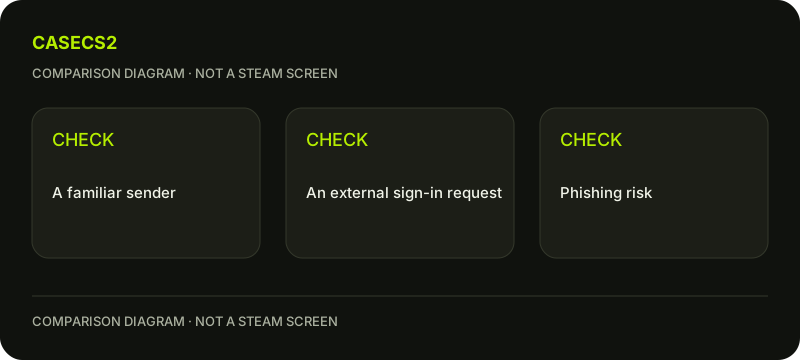
The important sequence is an unsolicited task becoming a request for sensitive access. Stop at that transition instead of treating urgency as evidence of legitimacy.
A check diagram, not a game screen.
Do not let familiarity verify the destination
Steam’s guidance explains that a known account can be used in this scam pattern. The sender being on a friends list therefore does not certify the linked page. Keep the account familiarity and site verification as two separate observations.
The profile-identity guide explains why display information has limits. This does not mean every legitimate tournament or voting activity is fraudulent. It means the particular unsolicited pattern should not inherit trust from a familiar profile without independent evidence of the event and its actual access requirements.
Avoid entering secrets or approving a QR request
Do not provide passwords, security codes or login approvals merely to satisfy an unexpected voting request. A copied logo and familiar-looking page cannot establish the real destination. Use the genuine login-address checklist before considering an authentication step.
The QR-login guide also emphasizes your own initiated action. An approval can have consequences even if the message describes it as a harmless vote. There is no need to perform a test login or visit the suspicious destination to understand why the request and the access demand must be evaluated separately.
Verify an event independently if you need to
If the event itself matters to you, find its official information independently through a known legitimate source. Do not use the suspicious message’s login route as the proof that its own story is true. Compare the task with the actual published event requirements.
You do not need to send the contact your authentication material to ask a question. A narrow conclusion can be that the destination remains unverified. The website login-and-return guide explains another reason to preserve the original task when an unrelated login request appears.
If credentials were entered, secure access first
Follow Steam’s official security guidance if you already exposed account access. Review authorized devices, the associated email and relevant account security controls. Preserve the actual observations rather than assuming that closing the page alone ends every authorized session.
If access is lost, use the official recovery guide. Recovery of access does not guarantee restoration of all items or removal of other restrictions. Keep the security task distinct from any later inventory or transaction question, each of which needs its own records and applicable conditions.
Keep the response proportional
Retain the message and destination context privately if needed. Where appropriate, use Steam’s official report or block controls based on the behavior you observed. Do not publish another person’s private details or organize messages to other users as a test.
A clear result is enough: the request was unsolicited, the login destination was not independently established, and no sensitive approval should follow merely from sender familiarity. That conclusion protects the original task without claiming every event is fake or that a suspicious message by itself proves the sender personally created the scam.
Sources checked on 2 November 2026. Labels and locations can vary by client version and language. Match the described state in your own current interface.
Help
Questions and answers
What you should know before you begin.
Is a message safe because a friend sent it?
Not necessarily. Steam describes compromised familiar accounts being used in this pattern.
Should I approve a login just to cast the vote?
Only consider authentication for an action you deliberately initiated and verified; an unsolicited vote request is not enough.
Does account recovery guarantee every item returns?
No. Access recovery and the status of specific item operations are separate questions.