Anodized Airbrushed: make broad colour transitions readable around a weapon
Plan where a broad colour transition should lead the eye before refining its softness. This exercise uses an original cool-to-warm sweep and compares the side with the top. The aim is a coherent arrangement around the model, rather than a transition that only looks convincing in one favourable picture. Valve describes Anodized Airbrushed as emulating freehand application of a coloured coat.
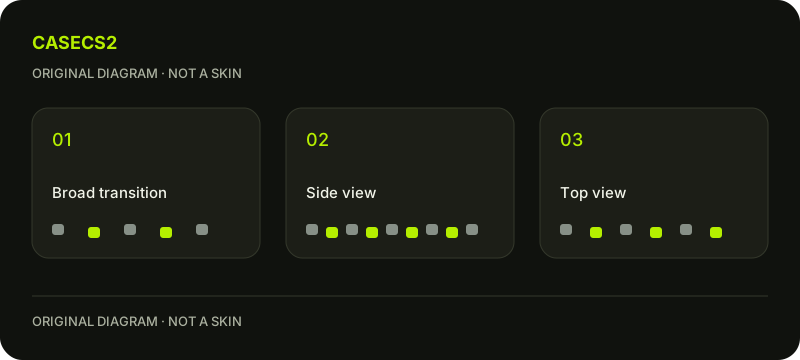
CASECS2Updated:
Plan a broad transition study
Original study
Intention
Question
Side view
Cool area leads toward warm area
Is the direction clear?
Top view
Continue the same broad idea
Does it feel related to the side?
Revised version
Calm one crowded transition
Does the whole become easier to read?
Use your own simple colour sweep. Avoid starting with tiny decorative marks: they make it harder to identify the broad movement you are trying to judge. Save a stable first version before changing its organisation.
A check diagram, not a game screen.
Write where the eye should travel
Choose a plain description such as “a quiet cool area leading toward a restrained warm focus.” Mark the intended starting area and destination on a separate sketch. This is a visual planning aid, not a required coordinate system or tool setting.
If the transition has no intended direction, describe the alternative goal, such as a balanced overall field. Either approach can guide a design, but switching between them while reviewing every new image makes the comparison difficult to interpret.
Read the side without chasing softness
Look at the largest colour areas first. Can you identify the planned movement at ordinary size? A beautifully soft local transition may still occupy the wrong place in the composition. Decide where it belongs before spending time polishing its small details.
Use the salience and contrast guide to describe what attracts attention. If a small bright area becomes the main feature, decide whether to retain that emphasis or revise its surroundings.
Compare the top with the same intention
Inspect the top-facing view of the same version. Record whether the broad idea remains related to the side or appears to turn into a different design. Do not demand identical pictures from different views; compare the intended relationship instead.
The mapping explanation offers context for a separate technical question. Here your note should identify the visual issue, such as a crowded warm patch, before you decide how to revise the artwork.
Make one transition revision
Keep the palette and overall intention fixed, then change one crowded area. Compare the old and new versions from both relevant views. If the side improves while the top becomes confusing, keep both observations rather than choosing only the flattering result.
Use matched lighting and check the in-hand composition. A large presentation image can hide the fact that the transition becomes a barely visible fragment during ordinary viewing.
Save the route and its unresolved view
Keep a small set of images with the intended visual direction and the actual result. A useful conclusion might say that the sweep reads clearly on the side, while the top needs a calmer warm area. That is a practical next revision, not a failure of the entire idea.
The submission guide concerns a later stage. A preview does not create a tradeable item or alter your inventory. Keep the outcome about the transition you designed, without claiming an existing skin, numeric material recipe or selection guarantee.
Sources checked on 2 November 2026. Labels and locations can vary by client version and language. Match the described state in your own current interface.
Help
Questions and answers
What you should know before you begin.
Should I refine softness before checking placement?
Check the broad arrangement first. Refinement cannot by itself fix a transition that leads attention to the wrong area.
Must the top look identical to the side?
No. Compare whether both views support the same design intention, not whether they produce identical images.
What if one revision helps only one angle?
Save the result for both angles and choose a targeted next edit. Do not erase the less successful observation.