Mark CS2 private without mistaking it for anonymous multiplayer
Marking a game private changes its exposure through Steam’s ownership, status and activity features; hiding it in your Library is mainly a local organizational choice. Neither should be described as anonymous CS2 play. Other players in the same multiplayer Steam matchmaking server can still see your SteamID, even when the game is marked private.
CASECS2Updated:
Choose the privacy goal precisely
Goal
Relevant feature
What it does not guarantee
Organize your own Library
Hide in Library
Ownership hidden from other people
Reduce Steam game exposure
Mark Private
Anonymous identity inside a match
Control inventory visibility
Inventory privacy
The same effect as private-game status
For example, removing a game from a normal Library view does not establish how another person sees your Steam activity. Decide which exposure you want to control before changing a setting. A clear goal avoids treating every option containing “hidden” as the same privacy mechanism.
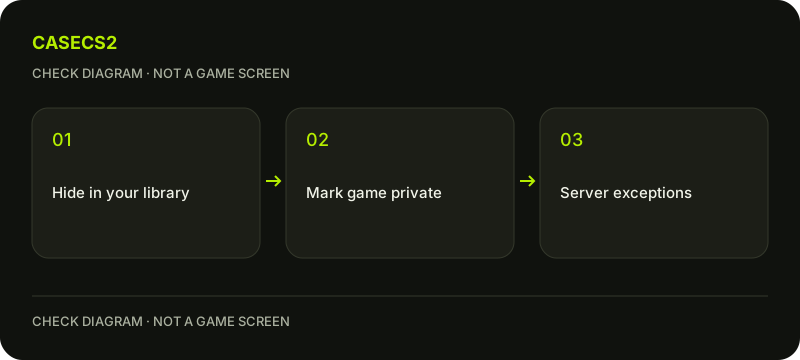
A check diagram, not a game screen.
Use the game’s private setting
Use an online, connected Steam client for the private-game change. Inspect the game’s management or Properties privacy controls for Mark Private. Steam also documents a route through the web profile’s games list. Follow the current function instead of relying on a fixed translated label.
Your own account should still be able to see the game; that is expected and not evidence the setting failed. Do not hide your entire profile merely to address one game unless that broader choice is independently what you want. Record the selected game and actual private state for a later review.
Understand the Steam exposure it addresses
Steam describes private games as hidden from other users across relevant ownership, in-game status, playtime and activity exposure. This is more than a personal Library filter, but it still has a defined scope. Read the current private-game help instead of extending that wording to every possible observation of your account.
If the concern is a public inventory, follow the inventory privacy check. Private-game status is not proof that the inventory is hidden or that a trade-link token is protected. These settings concern different information and should be checked independently.
Keep multiplayer visibility limits explicit
Steam says players sharing the same multiplayer Steam matchmaking server can still see your SteamID. An invited friend can also see the in-game status until you exit or disconnect. Do not describe the setting as an anonymous identity layer for CS2 servers.
The Steam account identity guide explains why identity is more than a nickname. Changing a game’s profile exposure does not rewrite the account participating in a match. It is not a way to bypass game restrictions, age conditions or access requirements.
Check website and shared-result privacy separately
Steam’s private-game setting does not control what you publish on a website or include in a screenshot. Review those materials separately. The support-evidence checklist helps reduce unnecessary disclosure in a troubleshooting image.
A saved inventory-builder plan follows the website’s own storage and sharing workflow, not Steam’s private-game flag. Keep public results, local drafts and Steam activity exposure distinct. Do not assume one setting revokes an already shared result or changes the information contained in a file you previously sent.
Verify only through legitimate perspectives
Review the owner-side setting, and if a permitted guest perspective is available, inspect the relevant profile exposure there. Do not send unsolicited test messages or require somebody else’s credentials just to verify a privacy choice. Record which view was actually checked and leave other views unknown.
Prime ownership and commercial eligibility do not change because a game is private; the Prime guide concerns another account feature. The useful completion note states the selected privacy control and its limits, especially multiplayer identity visibility, rather than promising that nobody can ever know the game is being played.