Test a repeating CS2 pattern for seams before inspecting the weapon
For a repeating pattern, check whether opposite source-image edges meet before diagnosing its placement on a weapon. A simple two-by-two arrangement of your own tile can reveal repeat seams. Then inspect the actual style and model separately: a clean repeated image does not guarantee that every UV-part join on the weapon will look continuous.
CASECS2Updated:
Separate two kinds of edge
Observation
First comparison
What it does not settle
Visible line between repeated images
Opposite tile edges
Every model-part join
Discontinuity between weapon parts
Style and model mapping
Whether the source repeats cleanly
Repeated motif changes size
Scale and preview conditions
A universal pixel resolution
Imagine an original dotted band that ends halfway through a dot at one image edge. Place copies together before blaming a weapon model. The band might reveal a source-repeat problem even without a three-dimensional preview. That is a narrower question than whether every surface on the model joins perfectly.
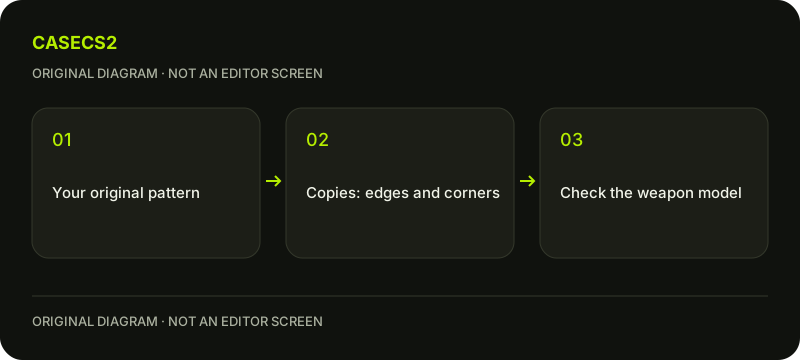
A check diagram, not a game screen.
Prepare a two-by-two source check
Duplicate your own source tile into a two-by-two arrangement, placing copies edge to edge without stretching them. This is an original practical checking method, not a claim that Valve requires this document layout or provides a specific button for it.
Use artwork you created or are entitled to use. Keep the original tile unchanged while inspecting the arrangement. Do not copy a published skin image and treat the resulting collage as your own material source. The submission review guide explains why a convincing preview does not establish originality or rights.
Inspect horizontal, vertical and corner joins
Look across the horizontal and vertical joins, then inspect the point where all four copies meet. Follow identifiable shapes rather than merely checking whether the overall colors seem similar. A small repeated edge feature can become conspicuous when several tiles appear together.
Revise one source edge relationship at a time and repeat the arrangement. Record what changed. Do not invent a universal overlap formula or stretch the copies until a seam disappears; that would change the test conditions and could hide the original discontinuity rather than resolving it in the tile.
Return to the actual finish preview
Valve’s style guidance recommends seamless patterns, and the technical guide explains that increased scale repeats a pattern. Test your source in the current supported Item Editor context for the chosen weapon and style, keeping placement and material conditions documented.
There is no universal pixel size or parameter preset supplied here. Different weapon sizes and the actual pattern behavior matter. The mapping guide explains why repeating-image continuity does not automatically solve joins across separated UV parts or a different projection method.
Keep light and material changes out of the seam diagnosis
If a boundary appears only under particular light, investigate whether material response contributes to the impression. Do not immediately repaint every edge. Keep the view and wear controlled, using the inspection-lighting guide as a comparison principle.
The PBR albedo guide also distinguishes source artwork from rendered lighting. A source tile and a lit model are not interchangeable evidence. This method concerns repeating patterns; it does not assert that every bespoke UV artwork or every finish style should be tiled in the same way.
Write the result at the correct scope
Record whether the source repeats without the observed edge, then separately state what happened on the selected model. An unresolved model join remains unresolved even when the two-by-two source check looks clean. Do not turn a partial result into a claim that the whole finish is complete.
For the wider workflow, consult the first-finish guide. A seamless test does not edit an owned skin, calculate a rare seed or guarantee selection. Its useful outcome is a specific, repeatable explanation of which boundary you examined and which stage still needs attention.
Sources checked on 2 November 2026. Labels and locations can vary by client version and language. Match the described state in your own current interface.
Help
Questions and answers
What you should know before you begin.
Does a clean tiled image guarantee every model join?
No. Source repetition and model-part mapping are separate checks.
Is the two-by-two arrangement a required Valve interface?
No. It is a practical author diagnostic using your own source artwork.
Is there one mandatory resolution in this guide?
No. Inspect the current style and weapon rather than using an invented universal pixel preset.