Steam Guard backup sign-in codes and Recovery Code are different
Steam Guard backup sign-in codes and the authenticator Recovery Code serve different purposes. Backup codes can replace a phone-generated code in the appropriate official login flow; the Recovery Code belongs to authenticator recovery. Treat both as sensitive, and do not assume they are interchangeable universal keys for signing in, approving trades or removing protections.
CASECS2Updated:
Separate the two kinds of preparation
Material
Documented purpose
Do not treat it as
Backup sign-in codes
Appropriate replacement for phone-generated login code
A universal trade approval
Authenticator Recovery Code
Future authenticator recovery
Every type of login code
Public support description
Explain what access is missing
A place to include either secret
For example, losing access to a phone may raise different questions about logging in and recovering the authenticator. Identify the requested task before using any private material. You can record that preparation exists without writing its secret contents into the same checklist.
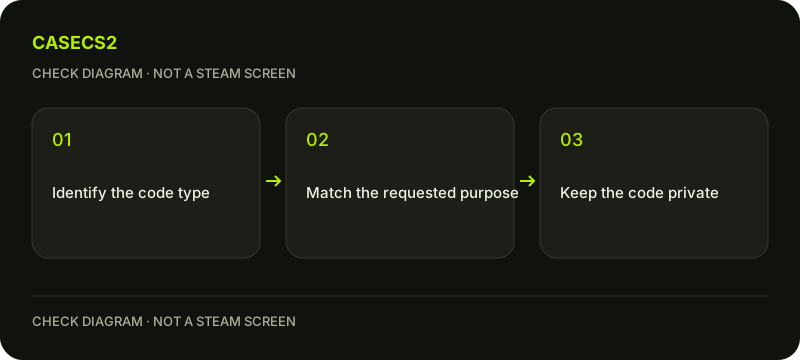
A check diagram, not a game screen.
Read the backup-code workflow conceptually
Steam documents backup-code access through Manage Steam Guard and Get Backup Codes, with SMS confirmation in that process. Use the current official account flow if you independently decide preparation is appropriate. Before beginning, make sure you have a private place to retain the resulting material and access to the required confirmation method.
Steam also describes email notifications when new backup codes are generated or used. That notification is a separate observation, not a reason to forward private material to somebody offering help. For questions about validity or an earlier set, read the current official instructions shown for that action rather than relying on another product’s code rules.
Keep the Recovery Code in its own role
The authenticator setup explains a Recovery Code for future recovery, and current help describes accessing that information through the Steam Guard area and its relevant settings. Exact client labels can vary, so read the actual official purpose before acting.
Do not assume that a recovery item shown in one context can be pasted into every authentication request. The Guard email guide concerns another factor, while the lost-authenticator guide focuses on unavailable mobile access. Different requests need their own appropriate response.
Choose private storage without collecting it elsewhere
Steam’s guidance favors printing backup codes rather than keeping a computer screenshot. Think about availability if the phone is lost, while keeping the material private and separate from ordinary public images. This is preparation, not a request to upload secrets to a website.
The support-evidence checklist explains why diagnostic images should exclude authentication material. Do not send codes to chat helpers or include them in a shared planning result. The inventory builder is not a secret-storage or recovery-code collection feature.
Do not turn a login fallback into a transfer approval
Using an appropriate backup sign-in code establishes a step in an official login flow; it is not approval of an item trade. Review the actual operation independently. The trade-confirmation guide concerns that separate decision.
Likewise, a request to reveal a code is not legitimate merely because somebody knows your profile name. Use the genuine login-address checklist before entering sensitive material. Keep Guard and the authenticator in place while identifying the requested factor; changing the security setup is a different task.
If both phone access and preparation are missing
Continue through official account or authenticator recovery rather than inventing a code or asking a stranger to supply one. Describe the unavailable factor without revealing whatever other private material remains. A recovery explanation does not need to collect your actual credentials.
A useful completion note says which preparation exists and where you can privately access it, without recording the secret in a public checklist. For example, a private note can distinguish preparation for sign-in from preparation for authenticator recovery. It should help you find the appropriate material without exposing it when you ask an ordinary support question.
Sources checked on 2 November 2026. Labels and locations can vary by client version and language. Match the described state in your own current interface.
Help
Questions and answers
What you should know before you begin.
Are backup codes the same as the Recovery Code?
No. They serve different documented sign-in and authenticator-recovery roles.
Should I show a screenshot to confirm I have them?
No. Keep the private material out of public evidence and messages.
Does a backup login code approve a trade?
No. Login authentication and confirmation of an item operation are separate decisions.