Remote Play picture quality: test one choice without losing the comparison
Name the visible defect before choosing a setting. Steam Remote Play provides speed-quality preference, bandwidth and capture-resolution settings. Those are possible areas to investigate, not a universal preset for every device. Use a scene with a clear edge, a quiet area and motion so you can describe what changed instead of announcing that the newest picture simply looks better.
CASECS2Updated:
Plan a fixed-scene worksheet
Scene feature
Initial observation
Question after one change
Clear edge
How distinct is it?
Did its reading improve?
Quiet area
Is unwanted visual activity present?
Did that activity change?
Motion
How does the scene hold together?
Was a new compromise introduced?
Use a private scene you can recognise and revisit. The worksheet does not prescribe a bitrate, resolution value or guaranteed quality outcome. Keep the host task stable enough to identify the effect of the choice you examine.
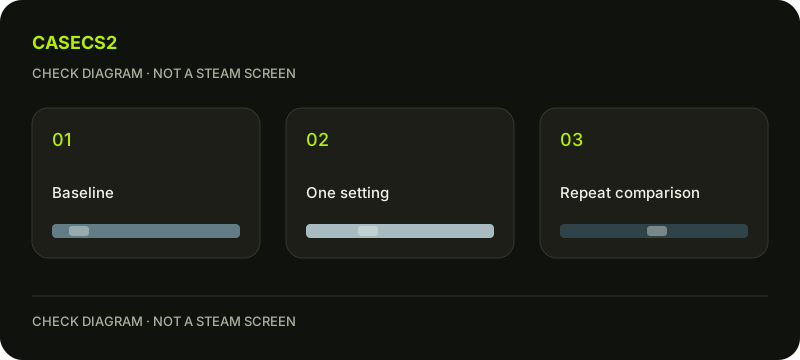
A check diagram, not a game screen.
Separate a streaming defect from an unclear host image
Look at the scene directly on the host first. If a detail is already unclear there, do not immediately blame remote delivery. Record the local appearance and the receiving result as separate observations before choosing the next comparison.
The skin texture settings guide addresses a local appearance question. Use it only when that is what you are actually investigating. A streaming preference should not be credited with restoring detail that the local scene did not display in the first place.
Choose one relevant decision
Write which available choice you plan to examine and why it relates to the defect. For instance, you may be investigating how a capture-resolution choice affects a particular edge. Keep other decisions unchanged for this comparison.
Do not copy an exact preset just because someone else calls it optimal. Your useful result is a documented change in this scene on these devices. If the current interface is unfamiliar, identify its meaning before changing several controls based on similar-looking names.
Compare motion as well as a paused impression
Review the same scene and write what changed in the edge, quiet area and motion. A crisper static image may introduce a compromise elsewhere. Keep that trade-off visible rather than selecting the most flattering instant as the whole verdict.
The performance monitor guide supports a separate local observation, while the recording timeline explanation helps avoid confusing different review materials. A saved video is not automatically the same evidence as the live receiving experience.
Reject comparisons with too many hidden changes
If the host scene, viewing size and several settings changed together, label the result exploratory rather than controlled. You can still learn which direction deserves another look, but cannot confidently attribute the improvement to one choice.
Return to the stable scene for a narrower follow-up. There is no need to make a purchase or alter network security to document a visual trade-off. The purpose is understanding which question remains, not promising that every defect has a quick setting-based repair.
Keep the preferred result with its limitation
Save the initial observation, changed decision and resulting compromise in a short note. Choose whether to retain the change, return to the earlier state or investigate another question separately. A preference can be conditional, such as clearer edges with motion still unresolved.
Use support evidence without secrets if the issue remains. The worksheet supplies no guaranteed bitrate, quality level or hardware recommendation. It leaves a traceable comparison so the next attempt does not begin with a fresh collection of unexplained settings and a forgotten baseline.