Why a Steam Support request closed and when it can reopen
A closed Steam Support request does not automatically mean account theft or an unanswered-request deadline. Steam distinguishes a user closing a solved request, automatic closure after waiting for the user’s input and agent closure. Read which situation applies before expecting a reopening option or treating every closure as the same event.
CASECS2Updated:
Classify the closure before counting days
Situation
Official distinction
Avoid assuming
User marks the request solved
Account-initiated closure
Every closure came from an agent
Waiting for your input
Automatic closure rule can apply
The same deadline applies while waiting for Steam
Agent addresses or ends the request
Agent closure context
Every case has the same reopen right
For example, a request waiting on your response is different from a request awaiting a support reply. Keep the last message and requested action with the closure observation rather than counting fourteen days from an unrelated starting point.
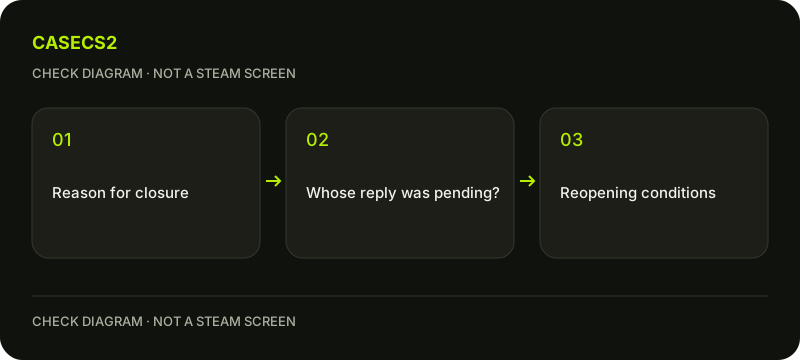
A check diagram, not a game screen.
Read the last request for information
Steam describes automatic closure after fourteen days only when the request is waiting for your input. Look at the last communication and identify whether something was requested from you. Do not present this as a universal response-time promise for Steam agents.
A user can close their own request as solved. An agent may also close a request considered addressed or outside scope, usually communicating that decision, with the policy’s exceptions. These reasons should remain separate. The fact that a request is closed does not by itself establish that someone else accessed the account.
Keep the private access link private
Steam explains that someone with the request-access link can view, reply to and close the request. Do not post it publicly as a convenient way for others to inspect your problem. A screenshot or a limited description can answer a technical question without granting that access.
The support-evidence checklist helps remove unnecessary details. If you suspect an unfamiliar person had access, preserve the relevant observations privately. Do not infer identity from a nickname or ask a stranger to open the link to prove whether it still works.
Apply the one-time reopening rule narrowly
Steam documents a once-only reopening through the “Not you?” action for requests closed by your account. That is a specific condition, not a promise that every agent-closed or automatically closed request can be reopened through the same route.
Read the request’s actual state before looking for the action. This guide does not invent a universal reopen button, appeal right or guaranteed processing time. If the documented condition does not apply, follow the official instructions for the current case rather than repeatedly opening duplicate requests to force a different interface.
Secure access before reopening a suspicious closure
Steam notes that a hijacker with account access, an authorized machine or a private request link can close a request. If that is a genuine concern, secure the relevant device, email and account access before reopening. Closure alone remains insufficient proof of a hijack.
Use the genuine login guide and shared-device exit guidance for their respective contexts. Do not disable Steam Guard or send authentication material to a helper. Reopening a request without understanding continued unauthorized access would leave the original concern unresolved.
Record the next step without creating a new claim
Keep the closure observation, last requested input and any actual account-initiated action together. Preserve displayed times as shown rather than declaring an undocumented timezone. If something remains unknown, say so instead of turning a missing message into an exact conclusion.
The login-and-return guide concerns website authentication, not the right to close or reopen a Steam request. This article does not create, close or reopen tickets. Its useful result is a correctly classified request and a legitimate next step, with private access protected and duplicate-message pressure avoided.
Sources checked on 2 November 2026. Labels and locations can vary by client version and language. Match the described state in your own current interface.
Help
Questions and answers
What you should know before you begin.
Does Steam close every unanswered request after fourteen days?
The documented automatic rule concerns requests waiting for your input, not a universal agent-response deadline.
Can every closed request be reopened once?
No. The described once-only option applies to requests closed by your account.
Is a request-access link safe to share publicly?
No. Steam says it can allow viewing, replying and closing the request.